Residual Entropy
The residual entropy, or erasure entropy, is a dual to the Dual Total Correlation. It is dual in the sense that together they form the entropy of the distribution.
The residual entropy was originally proposed in [VW08] to quantify the information lost by sporatic erasures in a channel. The idea here is that only the information uncorrelated with other random variables is lost if that variable is erased.
If a joint distribution consists of independent random variables, the residual entropy is equal to the Entropy:
In [1]: from dit.multivariate import entropy, residual_entropy

In [2]: d = dit.uniform_distribution(3, 2)

In [3]: entropy(d) == residual_entropy(d)
Out[3]: True
Another simple example is a distribution where one random variable is independent of the others:
In [4]: d = dit.uniform(['000', '001', '110', '111'])

In [5]: residual_entropy(d)
Out[5]: 1.0
If we ask for the residual entropy of only the latter two random variables, the middle one is now independent of the others and so the residual entropy grows:
In [6]: residual_entropy(d, [[1], [2]])
Out[6]: 2.0
Visualization
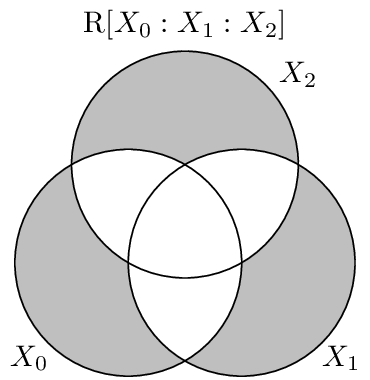
The residual entropy consists of all the unshared information in the distribution. That is, it is the information in each variable not overlapping with any other.

API
- residual_entropy(dist, rvs=None, crvs=None)[source]
Compute the residual entropy.
- Parameters:
dist (Distribution) – The distribution from which the residual entropy is calculated.
rvs (list, None) – The indexes of the random variable used to calculate the residual entropy. If None, then the total correlation is calculated over all random variables.
crvs (list, None) – The indexes of the random variables to condition on. If None, then no variables are condition on.
- Returns:
R – The residual entropy.
- Return type:
- Raises:
ditException – Raised if dist is not a joint distribution or if rvs or crvs contain non-existant random variables.