Entropy
The entropy measures the total amount of information contained in a set of random variables, \(X_{0:n}\), potentially excluding the information contain in others, \(Y_{0:m}\).
Let’s consider two coins that are interdependent: the first coin fips fairly, and if the first comes up heads, the other is fair, but if the first comes up tails the other is certainly tails:
In [1]: d = dit.Distribution(['HH', 'HT', 'TT'], [1/4, 1/4, 1/2])
We would expect that entropy of the second coin conditioned on the first coin would be \(0.5\) bits, and sure enough that is what we find:
In [2]: from dit.multivariate import entropy

In [3]: entropy(d, [1], [0])
Out[3]: 0.4999999999999999
And since the first coin is fair, we would expect it to have an entropy of \(1\) bit:
In [4]: entropy(d, [0])
Out[4]: 1.0
Taken together, we would then expect the joint entropy to be \(1.5\) bits:
In [5]: entropy(d)
Out[5]: 1.5
Visualization
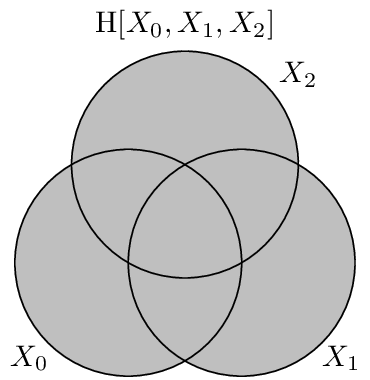
Below we have a pictoral representation of the joint entropy for both 2 and 3 variable joint distributions.

API
- entropy(dist, rvs=None, crvs=None)[source]
Calculates the conditional joint entropy.
- Parameters:
dist (Distribution) – The distribution from which the entropy is calculated.
rvs (list, None) – The indexes of the random variable used to calculate the entropy. If None, then the entropy is calculated over all random variables.
crvs (list, None) – The indexes of the random variables to condition on. If None, then no variables are conditioned on.
- Returns:
H – The entropy.
- Return type:
- Raises:
ditException – Raised if rvs or crvs contain non-existant random variables.
Examples
Let’s construct a 3-variable distribution for the XOR logic gate and name the random variables X, Y, and Z.
>>> d = dit.example_dists.Xor()
>>> d.set_rv_names(['X', 'Y', 'Z'])
The joint entropy of H[X,Y,Z] is:
>>> dit.multivariate.entropy(d, 'XYZ')
2.0
We can do this using random variables indexes too.
>>> dit.multivariate.entropy(d, [0,1,2])
2.0
The joint entropy H[X,Z] is given by:
>>> dit.multivariate.entropy(d, 'XZ')
1.0
Conditional entropy can be calculated by passing in the conditional random variables. The conditional entropy H[Y|X] is:
>>> dit.multivariate.entropy(d, 'Y', 'X')
1.0